B1・B2・B3班刊行物
角田太作 編『少数言語の基礎的言語資料 2001』(B-001)
Tasaku TSUNODA ed. "Basic Materials in Minority Languages 2001"
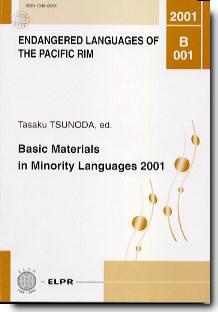
目次
CONTENTS
CONTENTS
| Introduction | Tasaku TSUNODA | 1 |
|
上ソルブ語クロストヴィッツ方言語彙集 Vocabulary in the Crostwitz dialect of Upper Sorbian |
笹原 健 Ken SASAHARA |
13 |
|
スヴァン語の語彙 Svan Vocabulary |
児島康宏 Yasuhiro KOJIMA |
27 |
|
ウォライタ語 語彙集 A Vocabulary of Wolaitta |
若狭基道 Motomichi WAKASA |
35 |
|
巴那语词汇集 A Vocabulary of Pana |
田口善久 Yoshihisa TAGUCHI |
83 |
|
クム語語彙 Khmu vocabulary |
加藤高志 Takashi KATO |
95 |
|
バンティック語テキスト バラロゴドとウヘイティネンデン Bantik Text: Bararogodo and Uheitinenden |
内海敦子 Atsuko UTSUMI |
105 |
| Wanyjirra texts: 76/13-2, NP(1), NP(2) | Tasaku TSUNODA | 115 |
| A Text in Chiriguano — Bolivian Guarani: 'El hombre que se muere de miedo' (The man who died of fear) | 白 尚源(ペック サンウォン) Sang-Won Peck |
205 |
|
ケチュア語クスコ方言のテキスト — ロバについて — A Text of Cuzco Quechua: AsnumaNta |
蛯名大助 Daisuke EBINA |
215 |
| Teaching about Pemon language and culture in a mainstream school in Venezuela | Veri Farina Becsky | 227 |
角田太作『少数言語の基礎的言語資料 2001 補遺』(B-001b)
Tasaku TSUNODA "Basic Materials in Minority Languages 2001 Addendum"
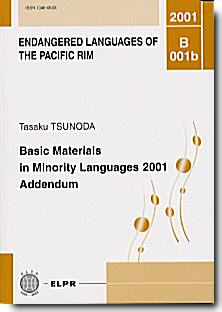 全文PDF/Fulltext PDF
CONTENTS
| Notes | Tasaku TSUNODA | 1 |
| Wanyjirra text: 76/13-2, NP(2) | Tasaku TSUNODA | 2 |
稗田乃編『言語間の接触において生じる言語現象』(B-002)
Osamu HIEDA ed. "Problems on Language Contact"
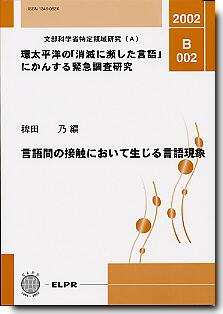
目次
CONTENTS
CONTENTS
|
言語接触において生じる言語現象の諸問題 — 言語交替と言語干渉 — Problems on Language Contact — Language Shift and Language Interference — |
稗田 乃 Osamu HIEDA |
1 |
|
マアの人々の言語使用の実際 Language Use of the Ma'a People |
安部 麻矢 Maya ABE |
8 |
|
言語接触による語彙の変容 —
ケレウェ語とジタ語に見られる語彙の類似化 — Lexical Change through Language Contact — The Case of Kerewe and Jita in Tanzania |
小森 淳子 Junko KOMORI |
34 |
|
サミア語の時制とアスペクトについて Tense and Aspect in Saamia |
稗田 乃 Osamu HIEDA |
65 |
|
ブラ語における中声調の分布について On the Distribution of Mid-tone in Bura |
塩田 勝彦 Katsuhiko SHIOTA |
88 |
角田太作 編『少数言語の基礎的言語資料 2002』(B-003)
Tasaku TSUNODA ed. "Basic Materials in Minority Languages 2002"
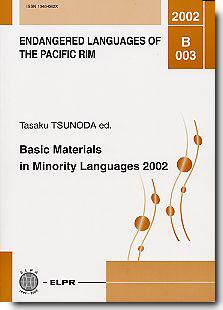
CONTENTS
| Introduction | Tasaku TSUNODA | 1 |
| Structure of a comprehensive presentation of a language, With a particular reference to the interface between text, grammar and lexicon | Christian Lehmann | 5 |
| Overview of Avar verbs with an infinitival complement | Hisanari YAMADA | 35 |
| Relative clauses in Xakass of Siberia | Yulia Koloskova | 57 |
| Introduction to the Luobohe Miao language (Written in Chinese) | Yoshihisa TAGUCHI | 71 |
| The double accusative possessor ascension construction in the Mitsukaido dialect of Japanese | Kan SASAKI | 91 |
| Bisu vocabulary | Takashi KATO | 115 |
| Wanyjirra text: 76/14-1, TM(1), TM(2) | Tasaku TSUNODA | 133 |
| A Cuzco Quechua text: yana michimaNta | Daisuke EBINA | 189 |
松村一登 編『ロシアの少数言語:文献ガイド』(B-004)
Kazuto MATSUMURA ed. "Indigenous Minority Languages of Russia: A Bibliographical Guide"
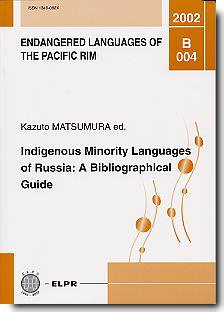
CONTENTS
| Preface | |
| Abaza | 1 |
| Aghul | 6 |
| Akhvakh | 11 |
| Aleut | 14 |
| Alutor | 20 |
| Andi | 24 |
| Archi | 28 |
| Bagvalal | 33 |
| Bezhta | 36 |
| Botlikh | 40 |
| Chamalal | 42 |
| Chukchee | 46 |
| Chulym | 50 |
| Dolgan | 52 |
| Enets | 60 |
| Even | 63 |
| Evenki | 68 |
| Godoberi | 82 |
| Hinukh | 84 |
| Hunzib | 86 |
| Itelmen | 89 |
| Izhorian | 94 |
| Kaitag | 98 |
| Karata | 101 |
| Kerek | 104 |
| Ket | 106 |
| Khanty | 110 |
| Khvarshi | 124 |
| Koryak | 126 |
| Kubachi | 135 |
| Mansi | 138 |
| Nanai | 147 |
| Negidal | 151 |
| Nenets | 153 |
| Nganasan | 162 |
| Nivkh | 164 |
| Oroch | 168 |
| Orok | 171 |
| Rutul | 174 |
| Sami | 180 |
| Selkup | 186 |
| Shor | 193 |
| Tat | 197 |
| Tindi | 202 |
| Tofa | 204 |
| Tsakhur | 207 |
| Tsez | 211 |
| Udege | 214 |
| Ulchi | 217 |
| Vepsian | 219 |
| Votian | 223 |
| Yug | 226 |
| Yukaghir | 228 |
| Yupik | 231 |
| Classified Index | 245 |
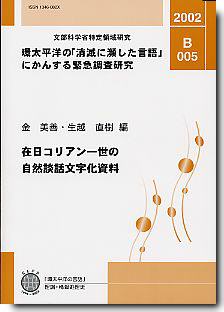
金美善・生越直樹 編『在日コリアン一世の自然談話文字化資料』(B-005)
KIM Mieon & OGOSHI Naoki eds.
"A Corpus of Discourses of a First-Generation Korean in Osaka Japan"
福井玲 編『TIPAマニュアル Version1.1』(B-006)
Rei FUKUI ed. "TIPA Manual Version 1.1"
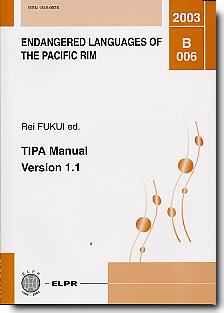
目次
CONTENTS
CONTENTS
| 1. Introduction | 1 |
| 2. TIPA Encoding | 5 |
| 3. Usage | 11 |
| 4. Customizing TIPA | 23 |
| Acknowledgments | 27 |
| Bibliography | 29 |
| Appendix | 31 |
| A Annotated List of TIPA Symbols | 31 |
| B Changes from Version 1.0 to 1.1 | 63 |
| C Symbols not included in TIPA | 67 |
| D FAQ | 69 |
| E Specimens | 73 |
| F Layout of TIPA fonts | 89 |
西光義弘 編『危機言語の調査方法』(B-007)
Yoshihiro NISHIMITSU ed. "Methods for Investigating Endangered Languages"
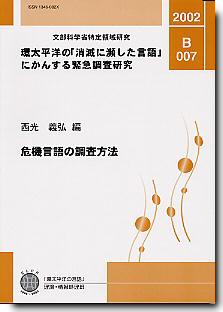
目次
CONTENTS
CONTENTS
| Theoretical Framework for Numeral Classifiers | Yoshihiro NISHIMITSU | 1 |
| The Transitivity Continuum | Yoshihiro NISHIMITSU | 15 |
| Japanese and Korean Causative Revisited | Masayoshi SHIBATABI and Sung Yeo Chung | 39 |
| The Causative Continuum | Masayoshi SHIBATANI and Prashant Pardeshi | 75 |
| The Origin and Development of Sri Lanka Portuguese Creole | Dileep CHANDRALAL | 127 |
|
ガガウズ語の二重格表示について Double Case Marking in Gagauz |
栗林裕 Kuribayashi, Yuu |
146 |
角田太作 編『少数言語の基礎的言語資料 2002(続編)』(B-008)
Tasaku TSUNODA ed. "Basic Materials in Minority Languages 2002 (Part 2)"
目次
CONTENTS
CONTENTS
| Introduction | Tasaku TSUNODA | 1 |
| A list of verbs of the Xotoda dialect of Avar | Hisanari YAMADA | 3 |
| Basic verbal vocabulary of the Sagay dialect of Khakas | Yulia Koloskova and Daria Bronnikova | 15 |
| Bisu vocabulary II | Takashi KATO | 25 |
| The generation difference in Bantik language | Atsuko UTSUMI | 45 |
| Wanyjirra text: 76/14-1, NP | Tasaku TSUNODA | 75 |
| Maqt'acha (A text in the Cuzco dialect of Quechua) | Daisuke EBINA | 147 |
梶茂樹 編『地方語と共通語における借用語の動態関係
— アフリカとインドネシアの場合 —』(B-009)
Shigeki KAJI ed. "Dynamics in Borrowing Relationship between Local Languages
and Liguae Francae, in Africa and Indonesia"
目次
CONTENTS
CONTENTS
| 序言 | 梶茂樹 | |
| 地図 | ||
| ハヤ語、アンコーレ語およびテンボ語における借用語 | 梶茂樹 | 1 |
| マテンゴ語における借用語と単語取り替え | 米田信子 | 31 |
| マリラ語における借用語 | 角谷征昭 | 51 |
| ルワ語(バンツー系)における借用現象についての報告 — 借用名詞の音対応を中心に — | 品川大輔 | 85 |
| ベンテ語における借用 — スワヒリ語からの借用を中心に — | 阿部優子 | 101 |
| アカン語アシャンティ方言における借用語 | 古閑恭子 | 131 |
| Lexical Borrowing in Degema | Ethelbert E. Kari | 141 |
| スンバワ語の借用語 | 塩原朝子 | 147 |
| バリ語の借用語 | 原真由子 | 177 |
| 執筆者紹介 | 201 |
鈴木麗璽・小野智香子・松村一登
『フィールド言語学者のための Unicodeツール』(CD1枚付き)(B-010)
Reiji SUZUKI, Chikako ONO and Kazuto MATSUMURA
"Unicode Tools for Field Linguists" (with 1 CD)
目次
CONTENTS
CONTENTS
| 1. はじめに | 1 |
| 2. 背景 | 3 |
| 3. Unicode フォント: LangSerif | 6 |
| 4. Unicode 入力補助ツール: UniInput | 8 |
| 5. 多言語辞書ツール: Dictool | 12 |
| 6. インストールのしかた | 24 |
| 7. ソフトウェアの利用について | 27 |
| 参考文献・参考URL | 28 |
| Unicode Tools for Field Linguists: A Brief Introduction | 31 |
| 図表 | |
| 図1: Unicode入力補助ツールUniInputの立ち上がりの画面 | 10 |
| 図2: チュクチ・カムチャツカ諸語入力用のキリル文字キー配列 | 10 |
| 図3: IPA音声記号のキー配列 | 11 |
| 図4: 辞書検索ツールDictoolの立ち上がり画面 | 13 |
| 図5: IPA表記の検索語(チュクチ語 )による検索 | 14 |
| 図6: キリル文字表記の検索語(ロシア語ropa)による検索 | 15 |
| 表1: 語彙データの形式 | 19 |
| 表2: IPA音声記号をASCIIコードで記述した『比較語彙集』の元ファイルからUnicodeへの変換テーブル | 20 |
| 表3: キリル文字をASCIIコードで記述した『比較語彙集』の元ファイルからUnicodeへの変換テーブル | 22 |
千葉庄寿『危機言語のコーパスの構築のために』(B-011)
Shoju CHIBA "Building and Exploiting Electronic Corpora of Endangered Languages"
目次
CONTENTS
CONTENTS
| 序論: 危機言語のテキストコーパスの構築にむけて | 1 |
| 第1章: 言語データとしての電子テキスト | 6 |
| 1.1 ファイル形式としてのテキスト | 6 |
| 1.2 テキストデータと「書式つきテキスト」 | 10 |
| 1.3 テキストデータとしてのUnicodeテキスト | 15 |
| 1.4 ソフトウエアのUnicode対応 | 17 |
| 1.5 Unicodeテキストの作成 | 27 |
| 1.6 Unicodeテキスト作成時に注意すべき点 | 49 |
| 1.7 Unicodeから他のエンコード方式への変換: 文字参照の利用 | 50 |
| 第2章: テキストコーパスの利用 — Unicodeテキストの検索 — | 57 |
| 2.1 電子化されたテキストの検索の前提 | 57 |
| 2.2 Unicodeテキストに対応した検索アプリケーション | 61 |
| 2.3 Unicodeテキストの効果的な検索 | 64 |
| 2.4 Unicodeテキスト検索ツール開発の技術的指針 | 74 |
| 第3章: 構造化されたコーパスデータ — XMLによる構造化と分析への応用 — | 77 |
| 3.1 構造化されたデータとは | 77 |
| 3.2 アノテーションフォーマットとしてのXML | 78 |
| 3.3 XMLデータの実例 | 81 |
| 3.4 XMLデータの作成 | 88 |
| 3.5 XMLデータの利用: データ構造を利用した検索の試み | 96 |
| 第4章: 補遺 利用ソフトウエアについて | 107 |
| 4.1 本稿で開発したソフトウエアの入手方法 | 107 |
| 4.2 Microsoft .NET Framework 実行環境の入手方法 | 108 |
| 4.3 本稿で紹介したその他のソフトウエアの入手方法 | 109 |
| 参考文献(附 参考 URI) | 110 |
| English Summary | 114 |
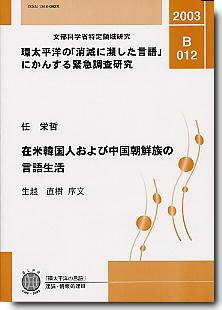
任栄哲(生越直樹 序文)『在米韓国人および中国朝鮮族の言語生活』 (B-012)
YIM Young Cheol with Preface by Naoki OGOSHI
"Language Life of Korean-American and Korean-Chinese Peoples"
目次
CONTENTS
CONTENTS
| 1 はじめに | 1 |
| 2 調査の概要 | 2 |
| 2.1 調査の方法 | |
| 2.2 調査地域・被調査者数 | |
| 2.3 調査対象者・調査期間 | |
| 2.4 分析の方法 | |
| 3 在米韓国人および中国朝鮮族の意識構造 | 4 |
| 3.1 祖国とのつながりと社会生活環境 | |
| 3.1.1 移住理由 | |
| 3.1.2 親戚・知人はいるか | |
| 3.1.3 住居地域 | |
| 3.1.4 交際範囲 | |
| 3.2 異文化への適応と家庭内の民族文化 | |
| 3.2.1 異文化への適応 | |
| 3.2.2 家庭内の民族文化の伝承度 | |
| 4 言語能力 | 10 |
| 4.1 韓国語の学習経験 | |
| 4.2 韓国語能力 | |
| 4.3 英語・中国語能力 | |
| 5 言語意識 | 15 |
| 5.1 韓国語を話す能力を持つべきか | |
| 5.2 韓国語の伝承意識 | |
| 5.3 外国語といったら何語が思い浮かぶか | |
| 6 言語行動 | 19 |
| 6.1 場面による言葉の使い分け | |
| 6.2 名前の使い分け | |
| 6.3 対人接触行動 | |
| 6.3.1 初対面の人との話題 | |
| 6.3.2 特別な用もなく、親しい同胞の友人と会って話をする時の話題 | |
| 6.3.3 同胞ではない友人と話をする時の話題 | |
| 7 言語変容 | 31 |
| 7.1 擬音語 | |
| 7.2 擬態語 | |
| 7.3 数・暗記 | |
| 7.4 夢の中 | |
| 8 おわりに | 38 |
| 参考文献 | 40 |
| 付録:在米韓国人および中国朝鮮族の言語生活 調査項目・単純集計表 | 41 |
| Korean/Korea-American Language Survey | 104 |
| About This Report | 118 |
| Language Life of Korean-American and Korean-Chinese Peoples | 119 |
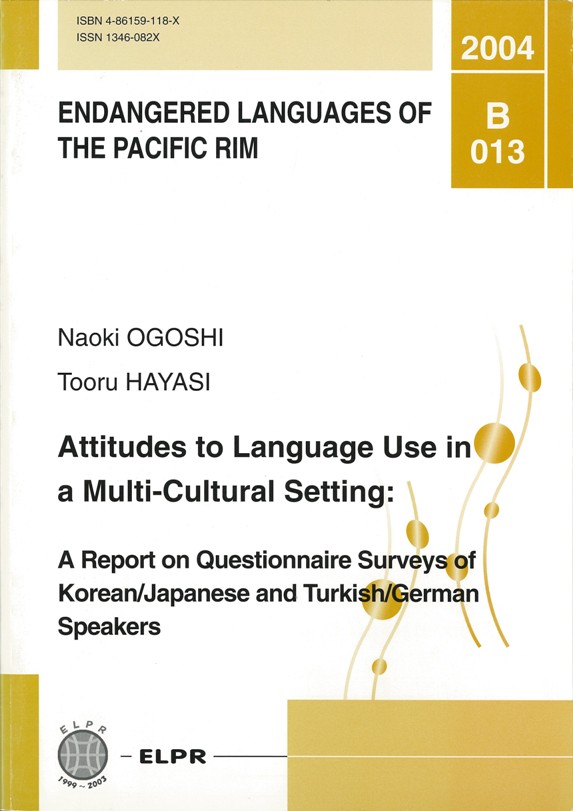
生越直樹・林徹『多文化状況での言語使用:
在日コリアンおよび在独トルコ系住民へのアンケート調査から』(B-013)
Naoki OGOSHI and Tooru HAYASI"Attitudes to Language Use in a Multi-Cultural Setting:
A Report on Questionnaire Surveys of Korean/Japanese and Turkish/German Speakers"
CONTENTS
PART ONE
PART TWO
| Introduction | v | |
| 序文 | ix | |
| 서문 | xiii | |
| Önsöz | xvii |
PART ONE
| The use and awareness of language and their change among Korean residents in Japan — From the survey results at a South Korean ethnic school — | Naoki OGOSHI | 1 |
| Appendix 1: Replies to questionnaire items of adults survey | 56 | |
| Appendix 2: Replies to questionnaire items of children survey | 75 | |
| Appendix 3: Questionnaire as to adults' language usage (in Japanese) | 89 | |
| Questionnaire as to adults' language usage (in Korean) | 94 | |
| Questionnaire as to children's language usage (in Japanese) | 100 | |
| Questionnaire as to children's language usage (in Korean) | 105 |
PART TWO
| Language use and awareness of Turkish students in Berlin — Survey report on a Gesamtschule in Kreuzberg — | Tooru HAYASI | 111 |
| Appendix 1: Replies to questionnaire items | 144 | |
| Appendix 2: Questionnaire forms | 153 |